Job Titles of the Future: Beyond the Head-Transplant Surgeon Hype
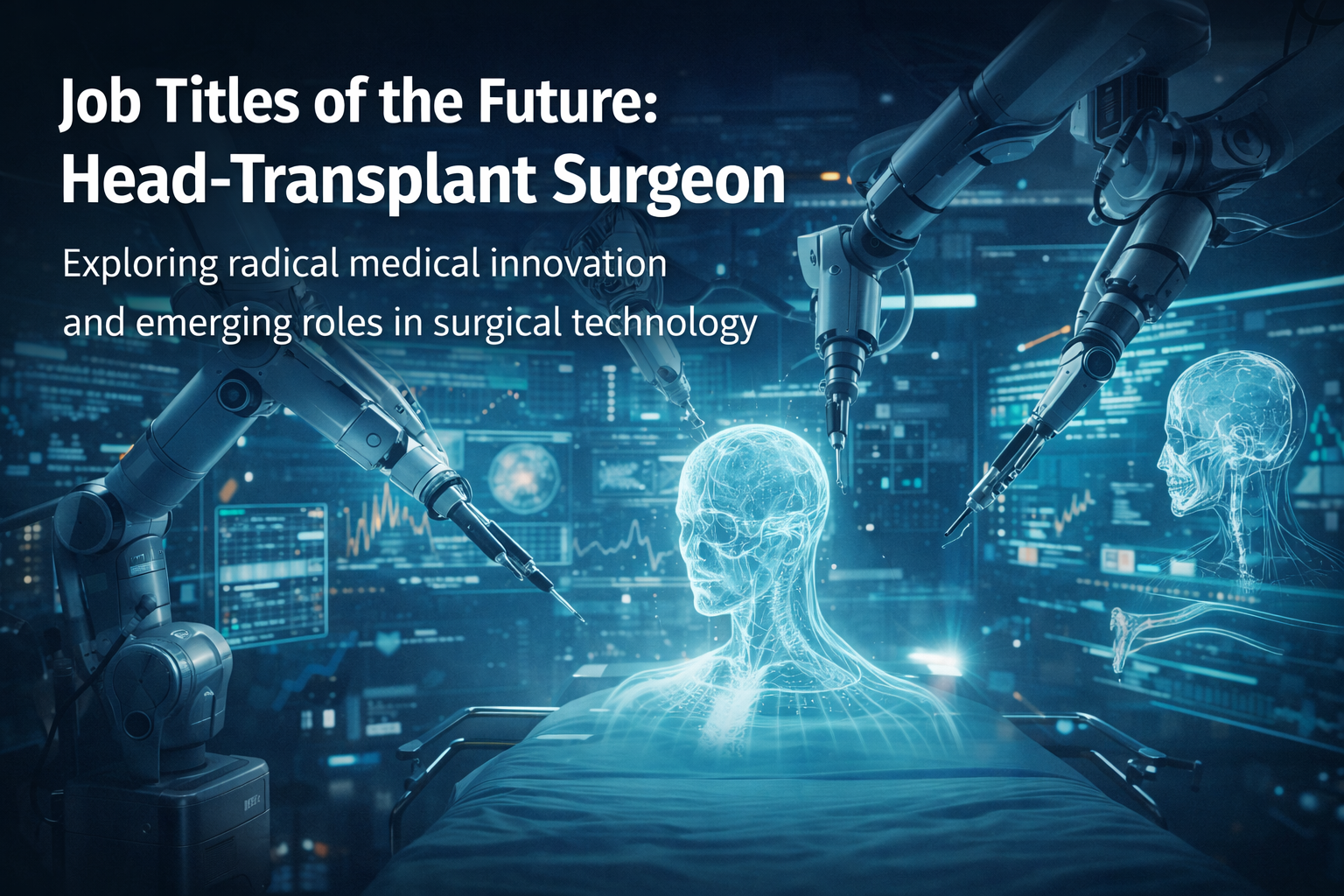
The constant evolution of technology doesn’t just change our tools; it fundamentally reshapes the roles we play. When speculative headlines like “Head-Transplant Surgeon” surface from futurist publications, they serve less as literal predictions and more as provocative thought experiments about the intersection of biology, engineering, and computation. For today’s developers, understanding these seismic shifts means looking past the shock value and focusing on the underlying technological drivers: advanced simulation, synthetic biology integration, and hyper-specialized AI deployment. The real jobs of the future will be built on today’s emerging stacks.
The Convergence of Cybernetics and Software Engineering
The notion of transplanting complex biological systems, whether human or purely electromechanical, necessitates a new breed of engineer. We are moving beyond traditional software development into an era where the line between physical hardware, firmware, and high-level application logic blurs completely. Consider the infrastructure needed to manage a synthetic organ or a neuro-interface system. This requires architects who don’t just understand Kubernetes clusters but also dynamic resource allocation in bio-reactors, or who can debug latency issues across neural networks distributed between silicon and wetware.
Developers in this space will need fluency in modeling complex, non-deterministic systems. This means deep proficiency in continuous integration/continuous deployment (CI/CD) pipelines adapted for biological systems, where rollbacks aren’t simply reverting a Docker image but potentially managing cascading failure states in living tissue. The core skillset shifts from managing cloud services to managing bio-digital interfaces with military-grade redundancy.
The Rise of Simulation Engineers and Digital Twin Architects
Before any high-stakes physical operation—whether it’s deploying a quantum chip or simulating a complex organ replacement—there must be an impeccable virtual counterpart. This drives the demand for Simulation Engineers whose primary domain is creating and maintaining high-fidelity digital twins. These aren’t simple CAD models; they are complex, multi-physics simulations that integrate fluid dynamics, electrical signal propagation, thermodynamic transfer, and machine learning models trained on real-world biological data.
For developers, this means mastering specialized simulation frameworks, often built on high-performance computing (HPC) infrastructure. Expertise in parallel processing, GPU computing, and developing efficient algorithms for real-time stress testing synthetic constructs becomes paramount. The ability to rapidly iterate a design in simulation, identify failure points that human intuition might miss, and translate those findings directly into actionable firmware or biological protocol updates defines this emerging role.
Specialists in Explainable Autonomy (X-AI) for Critical Systems
When AI governs life-critical systems—be it managing an autonomous surgical robot or optimizing cellular repair processes—trust and accountability are non-negotiable. The days of deploying ‘black box’ machine learning models in such sensitive domains are numbered. The future demands engineers specializing in Explainable Autonomy (X-AI).
This role bridges traditional software architecture with machine learning ethics and validation. Developers must build transparency layers into complex neural networks, providing auditable, human-readable justifications for every critical decision the system makes. This involves developing sophisticated logging and monitoring tools that track not just operational metrics, but causal pathways within the decision-making matrix of the AI itself. Understanding causality graphs and designing observability tools for non-linear, adaptive systems will be a core competency, moving far beyond standard application performance monitoring.
The Data Governance Challenge: Securing Bio-Digital Assets
If personal health data becomes inextricably linked with continuously operating cybernetic implants or synthetic tissues, the security implications are staggering. Developers won’t just be securing user passwords; they’ll be securing the operational parameters of human life support systems. This creates a massive opportunity for developers specializing in Bio-Digital Security and Data Integrity.
This specialization requires knowledge of zero-trust architectures applied to decentralized, often implanted, hardware nodes. It involves designing cryptographic protocols robust enough to withstand attacks targeting low-power, resource-constrained devices operating within the human body. Furthermore, data governance engineers will need to establish immutable audit trails for every modification made to a personal biological profile, ensuring compliance with hyper-strict regulatory frameworks that do not yet exist.
Key Takeaways
- Future roles will pivot towards managing cybernetic and biological integration, demanding fluency in physics simulation alongside traditional software stacks.
- Simulation Engineers who build and validate high-fidelity digital twins will be crucial for testing complex, high-stakes deployments before physical realization.
- Explainable Autonomy (X-AI) expertise will be mandatory for deploying autonomous systems in life-critical environments where auditability is essential.
- Security specialists must evolve to protect personalized, continuously operational bio-digital interfaces against novel physical and algorithmic threats.