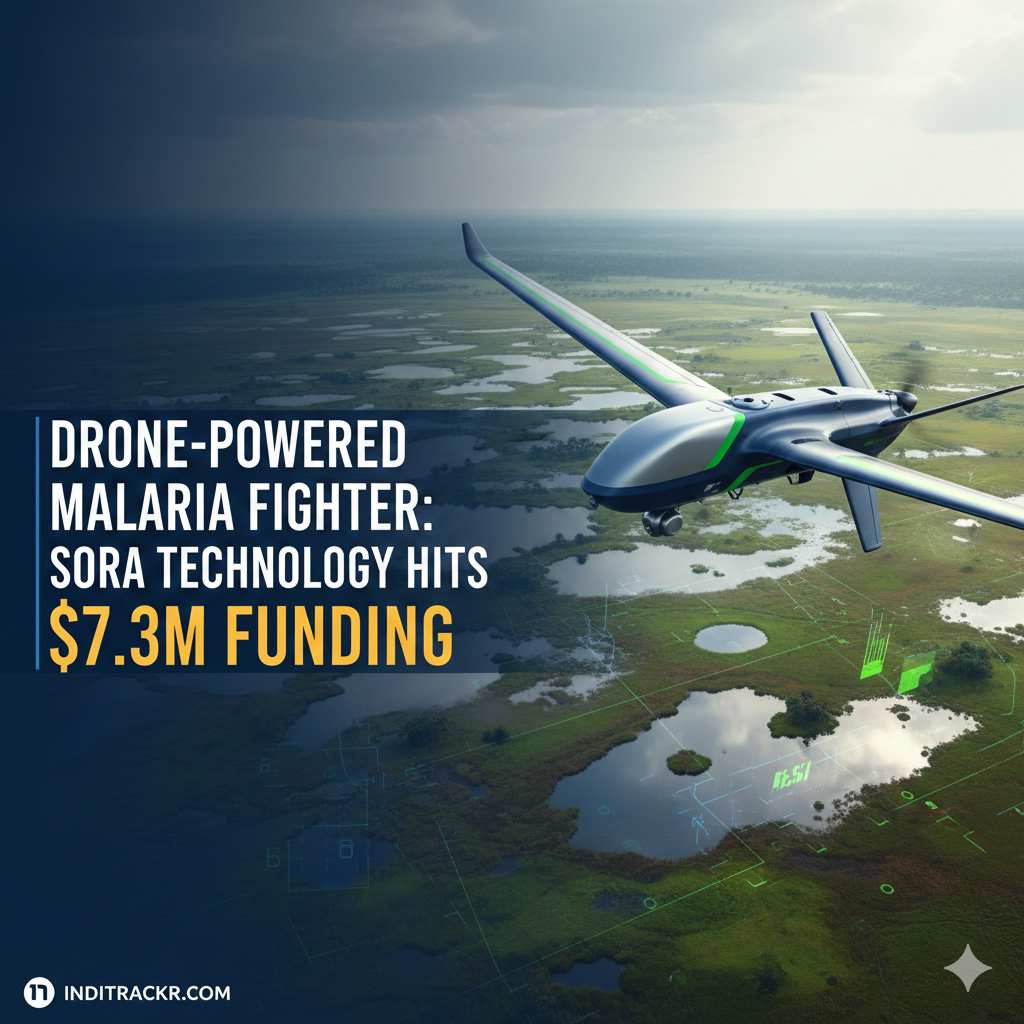
Drone-Powered Malaria Fighter SORA Technology Secures $7.3M Seed Funding for African Expansion
The intersection of advanced robotics, aerial technology, and public health intervention is rapidly evolving, presenting powerful new tools in the fight against devastating diseases like malaria. A recent significant injection of seed funding, totaling $7.3 million, has been secured by a specific technology utilizing autonomous aerial systems for disease vector control across the African continent. For developers and engineers focused on IoT, geospatial data, and large-scale deployment, this news signals a crucial shift in how software and hardware solutions are being integrated into critical global infrastructure.
Understanding the Core Technology: Autonomous Vector Control
At its heart, this funding is backing a system designed to optimize the release of anti-larval agents or bio-controls directly into breeding grounds identified via sophisticated mapping. Traditional methods often involve broad, inefficient spraying, leading to increased environmental impact and higher operational costs. The drone-powered approach fundamentally changes the data loop.
From a technical standpoint, this involves complex real-time processing. Developers are concerned with three main areas: accurate geospatial mapping, payload delivery precision, and robust fleet management software. High-resolution imagery, often collected by the same drone fleet, feeds into machine learning models trained to differentiate between water bodies suitable for vector proliferation and non-target areas. This demands robust image processing pipelines capable of running reliably even with intermittent connectivity, a common challenge in remote deployment zones. The precision needed for targeted droplet application requires highly calibrated flight control algorithms, far beyond standard waypoint navigation.
The Software Architecture Behind Scalable Deployment
Securing $7.3 million for expansion implies a massive undertaking in scaling the supporting software infrastructure. A fleet of dozens or hundreds of autonomous vehicles requires a centralized command and control system that manages everything from pre-flight diagnostics to post-mission telemetry analysis. Developers tackling this project must prioritize resilience and low-latency communication protocols.
The backend must handle terabytes of incoming sensor data—GPS coordinates, environmental readings, battery status, and payload levels. A key architectural challenge lies in designing a distributed ledger or database structure capable of logging every action (e.g., a release event) immutably for regulatory compliance and auditing. Furthermore, the mission planning interface needs to abstract the complexity of high-precision aerial application into a user-friendly dashboard for local health officials who may not have deep technical backgrounds. This necessitates excellent API design to ensure seamless integration with existing public health reporting frameworks.
Navigating Hardware and Firmware Challenges in Tropical Environments
While the funding focuses on expansion, the practical reality of deploying advanced robotics in diverse African environments presents significant hardware and firmware engineering hurdles. These drones are not operating in controlled laboratory settings. They face high heat, dust, humidity, and variable wind conditions. This requires custom thermal management solutions for onboard computing units and rigorous material science selection for airframes to ensure longevity.
Firmware development must incorporate sophisticated fail-safes. If GPS signal degradation occurs over remote marshland, the system must default to pre-loaded inertial navigation data or execute a safe landing protocol. Power management is equally critical; optimizing battery cycles for long missions while carrying a chemical payload demands finely tuned power distribution board logic and sophisticated battery monitoring embedded deeply within the flight controller software. The goal is maximum operational uptime, which relies entirely on reliable low-level code execution.
Implications for Future Health Tech Development
This successful funding round validates the model of using autonomous, data-driven platforms to solve persistent public health crises. For the wider developer community, it establishes a precedent: significant capital is available for solutions that merge complex engineering with clear societal impact metrics. It underscores the growing demand for developers proficient in areas like edge computing (processing imagery onboard the drone), resilient mesh networking for fleet communication in areas lacking cellular service, and designing secure data pipelines that protect sensitive geographical deployment information.
The expansion phase will inevitably lead to greater integration, potentially incorporating real-time disease surveillance data directly into the flight planning algorithms. Imagine a system that adjusts its distribution pattern not just based on historical breeding maps, but on active surveillance data streaming in from ground teams, triggering a deployment mission within hours of a positive detection. This level of responsiveness moves health intervention from reactive scheduling to proactive, automated response.
Key Takeaways
- The technological focus is shifting from generalized aerial mapping to hyper-precise, automated intervention delivery based on ML-processed geospatial data.
- Scaling requires robust, resilient software architecture capable of managing large fleets and handling high volumes of telemetry data securely and reliably.
- Hardware durability and firmware reliability in harsh, remote tropical conditions are paramount engineering challenges influencing operational uptime.
- This success highlights investor confidence in technology that bridges complex robotics with critical public health infrastructure in developing markets.