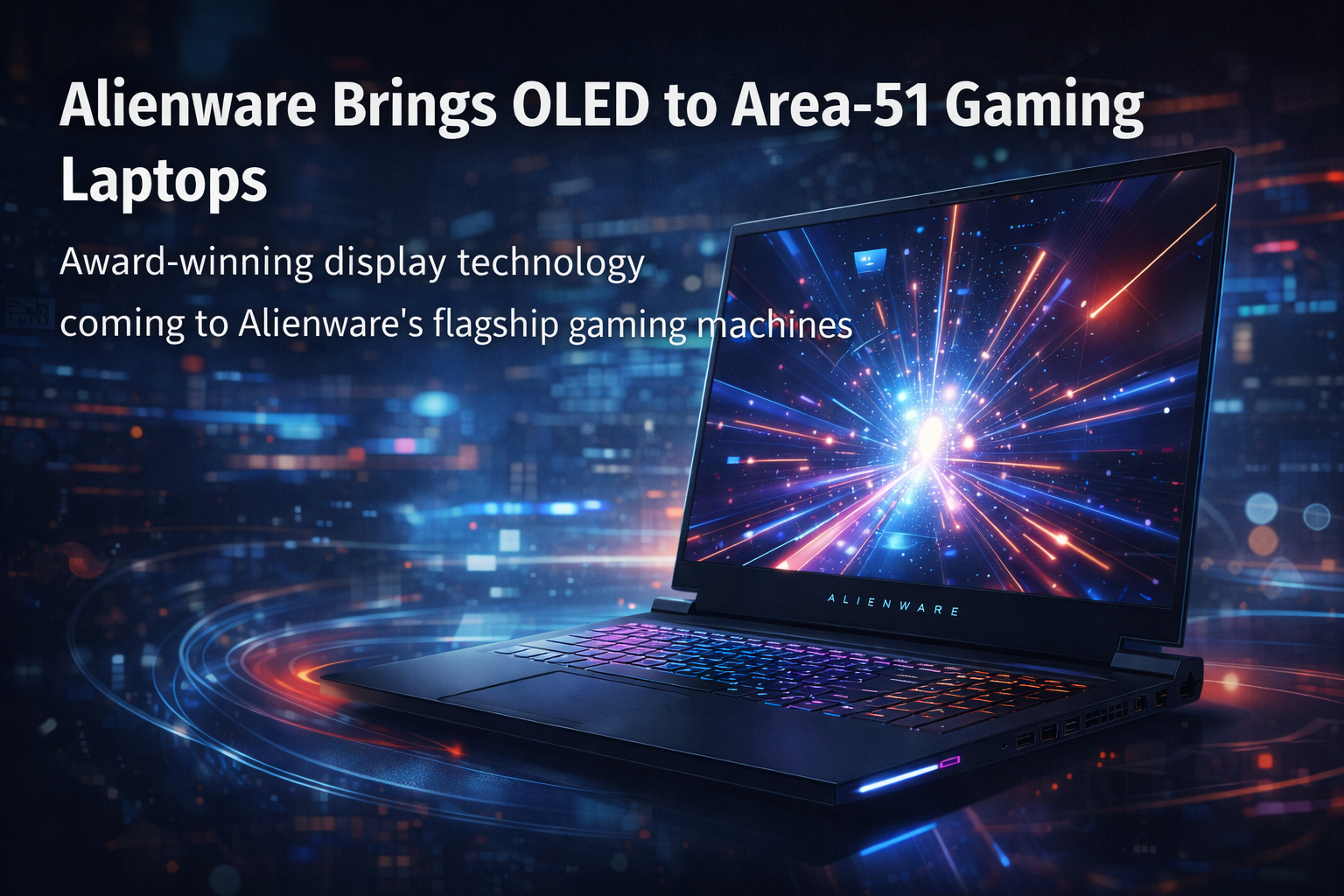
Revolutionizing Portable Gaming: Integrating Flagship OLED Displays into High-Performance Laptops
The convergence of extreme processing power and stunning visual fidelity has always been the holy grail for developers, especially those working in simulation, real-time rendering, and high-end game development. For years, the pinnacle of display technology—OLED—remained largely confined to desktop monitors and premium television sets. Recent announcements suggest a significant shift: integrating this superior display technology into flagship portable workstations previously known for their raw computational muscle. This move isn’t just about aesthetics; it represents a critical upgrade for performance validation and immersive development workflows.
Understanding the Technical Leap: Why OLED Matters for Developers
The transition from traditional high-refresh-rate LCD panels to OLED in portable gaming machines is fundamentally about pixel-level control. Unlike LCDs, which use a universal backlight that must be partially blocked to create black, OLED pixels generate their own light. This allows for true, absolute black rendering. For developers, this capability is invaluable for tasks requiring precise color grading, shadow verification, and dynamic range testing.
Consider debugging graphics pipelines. When testing deferred rendering techniques or complex global illumination solutions, accurately judging the depth of shadows and the fidelity of emissive materials is crucial. A display with a high contrast ratio, like OLED, immediately exposes subtle rendering errors that might be washed out or obscured by the ‘gray’ blacks of an IPS panel. Furthermore, the near-instantaneous response time inherent in OLED technology minimizes motion blur, offering a clearer view of fast-moving objects—essential when tuning physics simulations or high-frame-rate gaming engine performance.
The Implications of Low Response Times in Portable Systems
Latency is the silent killer of user experience and development accuracy. While the CPU and GPU handle the bulk of the workload, the display’s response time dictates how quickly the rendered frame is actually seen by the user. Traditional high-refresh-rate LCDs often boast fast gray-to-gray switching, but OLED excels due to its inherent switching speed, often achieving sub-millisecond transitions.
For developers building competitive applications or intricate timing mechanisms, this reduction in display latency offers a cleaner feedback loop. When profiling frame times or assessing input lag in a portable setup, having a display that doesn’t introduce its own measurable delay is paramount. This level of visual responsiveness allows engineers to more confidently attribute observed lag to software bottlenecks rather than hardware presentation delays. It elevates the laptop from a mere testing device to a genuine on-the-go production environment capable of mirroring a top-tier desktop setup.
Power Management and Thermal Considerations in High-End Laptops
Integrating OLED into a thermally constrained, power-hungry gaming laptop chassis presents significant engineering challenges. These machines are typically packed with high-TDP components designed to run under heavy load for extended periods. OLED panels, while efficient when displaying dark content, can draw substantial power when rendering bright, full-screen scenes. This impacts battery life, a key consideration for mobile productivity.
Engineers designing these systems must implement sophisticated power management profiles that dynamically adjust panel brightness and local dimming zones based on the application running. For the end-user developer, this means scrutinizing driver updates and control panel software to ensure that the display’s power consumption aligns with the desired operational mode—whether maximizing battery life during code reviews or unleashing full brightness for HDR material testing. Optimization of the display’s variable refresh rate (VRR) capability alongside the GPU’s output becomes a critical driver balancing visual smoothness against power draw.
The Shift in Portable Development Benchmarks
Historically, developers prioritized screen specifications based on resolution, refresh rate, and color gamut coverage (e.g., DCI-P3). The inclusion of OLED technology shifts the benchmark conversation toward contrast ratios, response times, and sustained peak luminance capabilities under various power states. This forces a re-evaluation of what constitutes a ‘performance’ machine.
For professionals developing cross-platform titles or specialized visualization tools, these portable OLED systems offer an unprecedented level of parity with professional desktop workstations. They validate the “what you see is what you get” principle regardless of location. This reduces the risk of integrating final visual assets on a mobile rig only to discover discrepancies when deploying to a final OLED-equipped target display.
Key Takeaways
- OLED integration provides true black levels and superior contrast, crucial for accurate color grading and shadow testing in graphics development.
- Near-instantaneous pixel response times minimize display latency, offering developers a cleaner feedback loop for performance profiling and input lag analysis.
- System engineers face new power management challenges to balance high brightness demands with the thermal and battery constraints of portable gaming chassis.