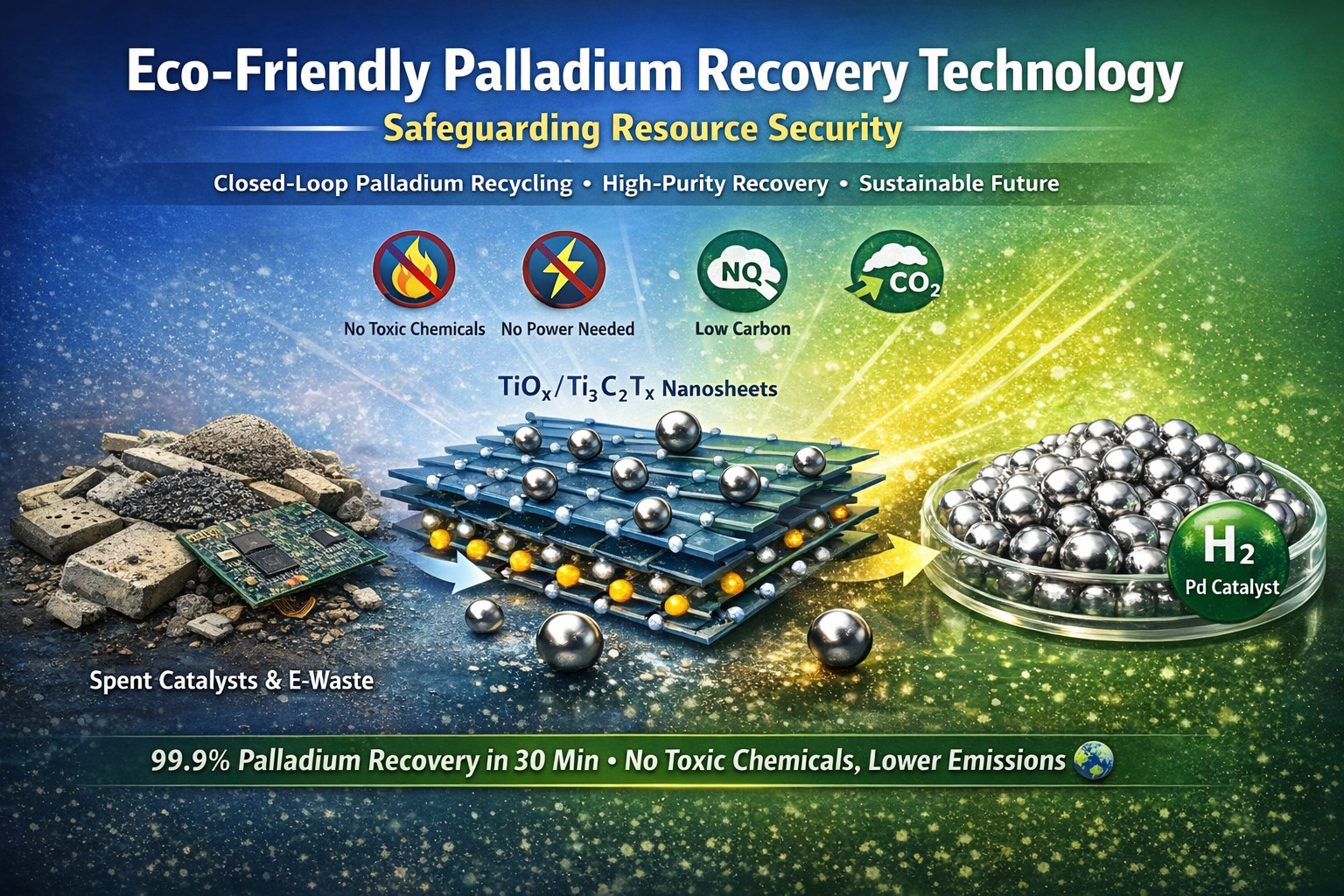
Sustainable Palladium Recovery: A Developer’s Guide to Eco-Friendly Resource Security
The global push for sustainability is increasingly intersecting with high-tech material science, especially concerning precious metals critical for modern electronics and catalysis. Palladium, vital for automotive catalytic converters, fuel cells, and advanced circuitry, faces increasing supply chain pressures and environmental concerns related to traditional extraction. For developers working on environmental monitoring, resource management software, or novel chemical processes, understanding advancements in eco-friendly palladium recovery is not just academic—it’s crucial for building the next generation of sustainable technology solutions. This article explores the advancements highlighted in recent research concerning sustainable palladium recovery and what these mean for the engineering community.
The Scarcity Challenge and the Need for Circularity
Palladium is classified as a critical raw material due to its scarcity and high demand. Traditional mining operations are energy-intensive, often involve harsh chemicals, and generate significant waste. As the world shifts towards cleaner energy sources, the demand for palladium in technologies like hydrogen fuel cells is projected to increase, straining existing supplies. This impending resource constraint demands a fundamental shift from linear consumption (mine, use, dispose) to a circular economy model. For developers, this translates into opportunities to design systems that optimize material tracking, predict recycling efficiency, and integrate secondary sources seamlessly into manufacturing pipelines.
From a systems architecture perspective, the challenge lies in creating robust, scalable processes that can handle the heterogeneous nature of electronic waste (e-waste) and spent catalysts. Data infrastructure for tracking material provenance, degradation rates, and optimal recovery points becomes an essential component of any future sustainable supply chain strategy.
Advancements in Low-Impact Palladium Extraction Techniques
Recent technological progress focuses heavily on replacing high-temperature pyrometallurgical processes—which are energy-intensive—with gentler, more selective hydrometallurgical or bio-assisted techniques. The goal is higher purity yields with a drastically reduced environmental footprint.
One significant area involves solvent extraction modifications. Traditional solvent extraction can be effective but often relies on hazardous organic solvents. Modern research explores task-specific ionic liquids (TSILs) or deep eutectic solvents (DESs) engineered at the molecular level. Developers designing process control software need to understand the kinetic parameters of these novel solvents. For instance, the partition coefficient of palladium relative to platinum or rhodium in a DES system changes significantly based on temperature and pH modulation, requiring highly precise, real-time sensor feedback loops for maximizing separation efficiency.
Another exciting frontier is bio-leaching, or biosorption. Certain microorganisms or synthesized biosorbents (like functionalized biopolymers) exhibit high selectivity for adsorbing precious metals from dilute solutions. This is particularly relevant for recovering trace amounts of palladium from complex industrial wastewater streams or low-grade e-waste leachates. Programmers tasked with optimizing these bioprocesses must incorporate complex biological kinetics models, adapting machine learning algorithms to manage variables such as microbial population health, nutrient dosing, and flow rates within bioreactors to ensure consistent metal uptake rates.
Engineering for Material Recovery Efficiency: Software and Hardware Synergy
The success of eco-friendly recovery hinges not just on the chemistry but on the engineering infrastructure supporting it. Developers play a critical role in bridging the gap between laboratory innovation and industrial deployment. This requires sophisticated monitoring and control systems.
Consider the integration of sensor technology. For instance, in an electrochemical recovery cell designed for high purity, real-time monitoring of electrode surface conditions using electrochemical impedance spectroscopy (EIS) is necessary. The resulting high-dimensional data sets must be processed instantly to adjust voltage parameters to prevent co-deposition of impurities. Software engineers must build resilient APIs capable of handling rapid streams of sensor data from diverse industrial instrumentation.
Furthermore, material characterization software is evolving. X-ray fluorescence (XRF) and scanning electron microscopy (SEM) data, historically analyzed offline, are increasingly being integrated directly into operational feedback loops. Developing robust computer vision algorithms trained on characteristic spectral fingerprints of palladium-containing matrices allows for automated quality control during feedstock preparation, ensuring that only optimal material enters the recovery stream, thereby minimizing reagent consumption.
Safeguarding Resource Security Through Decentralized Recovery Solutions
Moving towards genuine resource security means establishing distributed, decentralized recovery capabilities rather than relying solely on centralized refineries. This opens avenues for modular, smaller-scale recovery units deployable closer to the source of waste (e.g., automotive repair shops or small-scale electronics recyclers).
For developers, this points toward creating standardized, containerized process blueprints—essentially, software packages that contain the entire operational logic, safety interlocks, and material modeling required to run a specific recovery chemistry using off-the-shelf hardware components. The challenge here is standardization across geographically diverse regulatory environments while maintaining chemical efficacy. Blockchain technology could also play a role in creating an immutable ledger for tracking the recovery chain of custody, verifying that “recycled” palladium truly re-enters the supply chain responsibly.
Key Takeaways
- Sustainable palladium recovery demands a shift from traditional high-energy mining to advanced, selective chemical and biological processes.
- Developers must focus on integrating real-time sensor data (like EIS) to precisely control novel solvent extraction and electrochemical recovery systems.
- Opportunities exist in creating robust data architectures for material traceability and process optimization, leveraging machine learning for complex kinetic modeling.
- The future involves decentralized, modular recovery units, requiring standardized, software-defined process blueprints for broad industrial adoption.