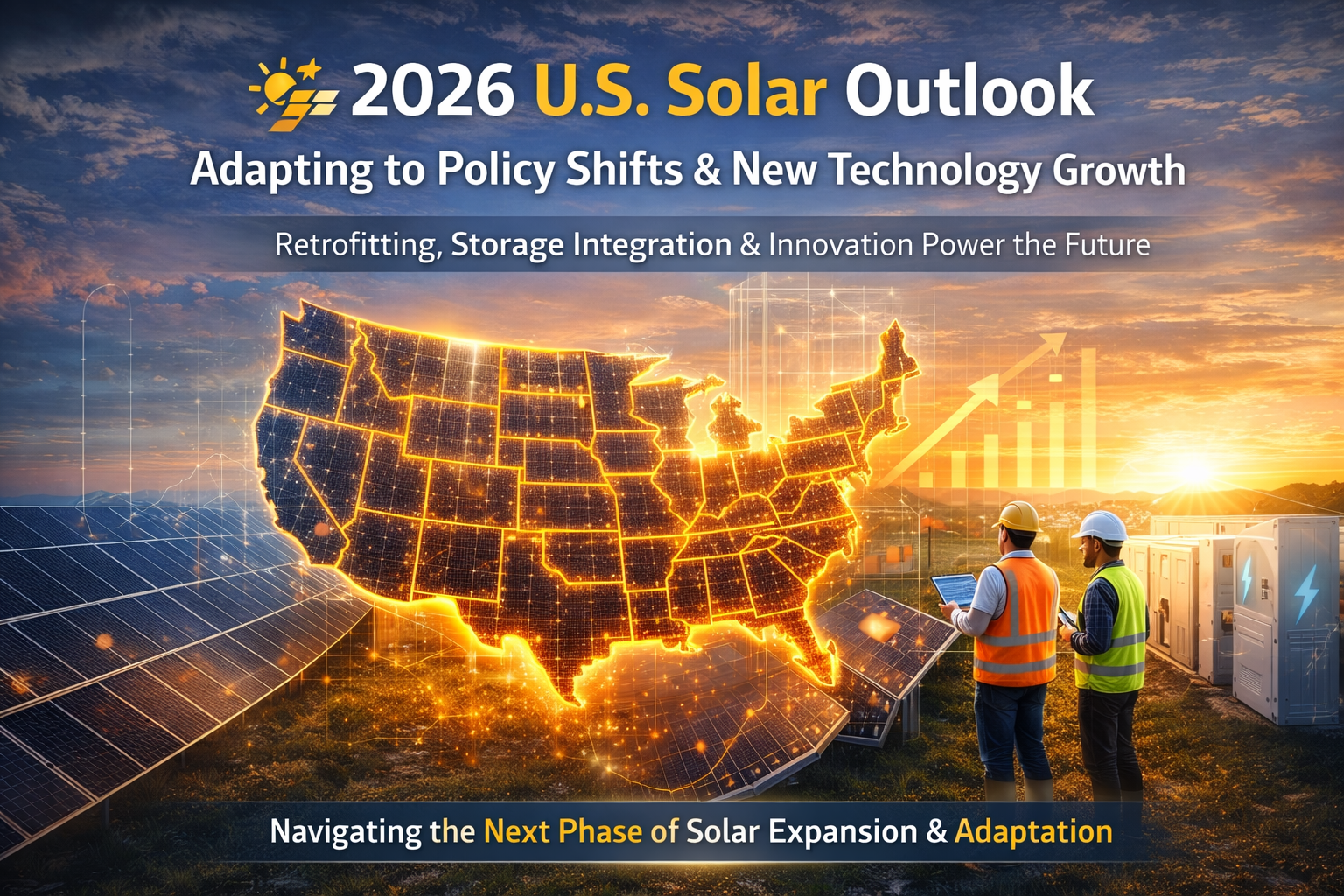
2026 Outlook: U.S. Solar Adapts to Policy Shifts as Retrofitting and New Technology Drive Growth
The landscape of U.S. solar development is undergoing a significant transformation as we approach 2026. Driven by evolving federal and state policies, fluctuating supply chain dynamics, and rapid technological advancements, developers and engineers must pivot their strategies to maintain momentum. The era of purely greenfield project deployment is giving way to a more nuanced approach emphasizing efficiency gains, integration challenges, and the untapped potential of existing infrastructure. For the development community, success in the next few years hinges on mastering the intricacies of policy adaptation and leveraging emerging hardware and software solutions.
Navigating the Shifting Policy Terrain
Federal incentives remain foundational, but the specific mechanisms and timelines are creating new engineering hurdles. Changes in investment tax credit (ITC) eligibility windows and the evolving structure of domestic content requirements necessitate more rigorous upfront planning. Developers are finding that compliance is no longer a paperwork exercise; it directly impacts module procurement strategies and the bill of materials. For instance, meeting stricter domestic sourcing thresholds often means integrating alternative supplier technologies that may require different inverter matching protocols or racking systems. Engineers must be proficient not just in energy yield assessments but also in simulating the cost and performance implications tied directly to current legislative compliance standards. This requires tighter integration between financial modeling teams and the core engineering design process, treating policy adherence as a primary constraint rather than a secondary verification step.
The Rise of Solar Retrofitting and Repowering
Perhaps the most significant shift is the increased focus on existing solar assets. As the first wave of utility-scale projects installed between 2015 and 2020 begins to approach warranty expirations or efficiency plateaus, the demand for sophisticated retrofitting and repowering solutions is exploding. This is a fertile ground for developers skilled in brownfield integration. Retrofitting presents unique technical challenges compared to greenfield development. Site constraints are fixed, requiring careful module replacement that optimizes for minimal disruption to existing cabling and racking structures. Furthermore, integrating newer, higher-efficiency modules with older inverter fleets demands sophisticated power electronics management to avoid clipping losses or cascading failures. Software expertise in monitoring legacy SCADA systems and implementing seamless data migration paths for modern asset management platforms is becoming a crucial competitive differentiator.
Technological Drivers: Storage Integration and Advanced Inverters
The growth trajectory of U.S. solar is now inextricably linked to energy storage. By 2026, co-located storage will transition from being a preferred add-on to a near-mandatory component for utility interconnection, especially in capacity-constrained regions. Engineers must master the design complexities of DC-coupled versus AC-coupled systems. DC coupling offers higher round-trip efficiency but demands more complex site planning regarding thermal management and fire safety standards for co-located battery enclosures. AC coupling provides more flexibility for phased deployment and easier integration with existing grid infrastructure but introduces conversion losses. The selection process involves deep analysis of expected load profiles, arbitrage opportunities, and local grid service requirements.
Furthermore, advances in inverter technology, particularly those capable of sophisticated grid-forming capabilities, are critical. These inverters allow solar installations to provide essential grid stability services previously exclusive to synchronous generators. Developers need robust simulation tools to model the dynamic response of these inverters under various fault conditions, ensuring the project delivers reliable ancillary services as required by evolving transmission operator mandates.
Optimizing Operations with Predictive Analytics
To maximize returns on both new and retrofitted assets under tighter financial margins, operational efficiency through advanced analytics is paramount. The focus is moving beyond simple reactive maintenance based on threshold alarms. Predictive maintenance powered by machine learning applied to granular sensor data (irradiance, temperature, voltage, current) allows for pinpointing underperforming strings or incipient component failures before they impact production significantly. For large portfolios, deploying scalable, cloud-native analytics platforms that can ingest heterogeneous data formats from various inverter and tracker vendors is a significant engineering undertaking. The developer’s role is expanding to include the architecture and validation of these data pipelines, ensuring data quality is high enough to train reliable forecasting and anomaly detection models.
Key Takeaways
- Policy compliance, especially domestic content rules, must be integrated early into hardware procurement and engineering design decisions.
- Retrofitting and repowering existing solar farms present complex integration challenges requiring expertise in mixed-technology power electronics and site adaptation.
- Mandatory energy storage integration necessitates deep engineering knowledge in selecting between DC-coupled and AC-coupled architectures based on project economics and site constraints.
- Advanced inverter capabilities, particularly grid-forming features, are becoming essential for successful interconnection in constrained transmission areas.
- Operational success in 2026 relies heavily on implementing robust, scalable predictive analytics platforms for portfolio-wide O&M optimization.