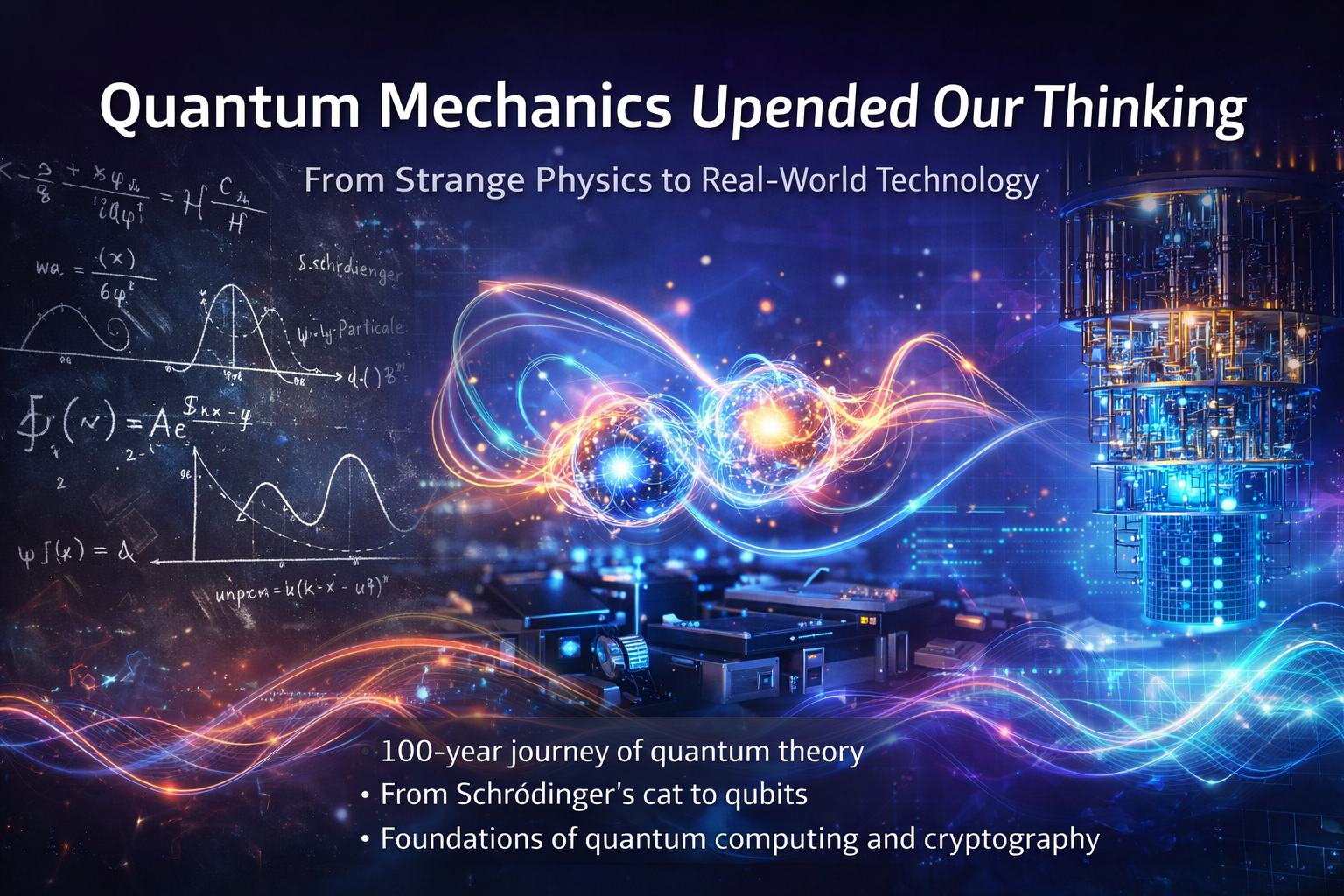
Quantum Mechanics Upended Our Thinking: A Developer’s Perspective on Fundamental Change
The quote, “Quantum mechanics upended our thinking,” resonates deeply within the world of software development and computing. While many developers spend their days wrestling with object-oriented paradigms, distributed systems, or API design, the foundational shift introduced by quantum mechanics has profound implications for the future of computation itself. Understanding this historical and conceptual upheaval is not just academic; it prepares us for the next major paradigm shift in technology: the move from classical bits to quantum qubits.
The Collapse of Determinism in Physics and Code
Classical computing is built on certainty. A bit is either 0 or 1. An operation either succeeds or fails. This deterministic nature mirrors the Newtonian physics that underpinned early engineering. Quantum mechanics, however, shattered this comfortable certainty. At the core of the quantum revolution is the probabilistic nature of reality at the subatomic level. An electron doesn’t have a definite position until it is measured; before measurement, it exists in a superposition of possibilities.
For developers accustomed to sequential execution and binary states, this conceptual leap is significant. When we translate this to quantum algorithms, we move from processing single paths of logic to exploring vast landscapes of potential solutions simultaneously. This isn’t just faster processing; it’s fundamentally different processing. We are no longer optimizing sequential steps; we are engineering interference patterns within probability distributions. This requires a shift in mindset from debugging logical flow to validating statistical outcomes of complex superposition states.
Superposition and Entanglement: New Primitives for Computation
The two key concepts that break classical computing analogies are superposition and entanglement. Superposition allows a quantum bit, or qubit, to exist as a combination of 0 and 1 simultaneously. For a system of N qubits, this allows for the representation of 2^N states concurrently. This exponential growth in representational power is the engine behind quantum computational advantage.
Entanglement is perhaps the stranger concept. Two entangled qubits share a fate regardless of the physical distance separating them. Measuring the state of one instantly dictates the state of the other. In programming terms, imagine two variables that are inextricably linked—changing one forces the other to assume a corresponding state, violating the local causality we rely on in standard network programming and state management. While we won’t likely use entanglement directly in standard application code, its exploitation is crucial for error correction and achieving true quantum parallelism.
Developers engaging with quantum programming interfaces (SDKs) must learn to think in terms of unitary transformations—rotations on a sphere representing the qubit state—rather than traditional Boolean logic gates. The building blocks are now matrices that manipulate probability amplitudes, not simple logic checks.
The Impact on Cryptography and Security
The most immediate, and perhaps most disruptive, real-world implication of quantum computing stems from Shor’s algorithm. Most modern public-key cryptography, which secures everything from financial transactions to secure communications, relies on the mathematical difficulty of factoring large prime numbers (RSA) or solving discrete logarithm problems (ECC). Quantum computers, leveraging superposition to check all potential factors simultaneously, can solve these problems exponentially faster than any classical machine.
This necessitates a massive, proactive overhaul of the global cryptographic infrastructure. Developers today must start learning about and planning for the integration of post-quantum cryptography (PQC) algorithms. PQC focuses on developing mathematical problems that are hard for both classical and quantum computers to solve. This transition involves updating libraries, understanding new signature schemes, and ensuring system resilience long before fault-tolerant quantum machines become ubiquitous. The upending of thinking here is realizing that today’s security bedrock will become tomorrow’s vulnerability.
Reframing Optimization Problems for the Quantum Age
Quantum mechanics doesn’t speed up every computation; it excels at specific classes of problems where the search space grows exponentially, such as simulation, optimization, and machine learning feature space exploration. Grover’s algorithm, for example, offers a quadratic speedup for unstructured search problems.
For developers working in fields like logistics, finance, or material science simulation, the quantum promise lies in reformulating existing problems. Instead of writing iterative refinement loops, the task becomes mapping the problem constraints onto the physical structure of a quantum processor—designing the Hamiltonian that represents the energy landscape of the desired solution. This requires a deep collaboration between domain experts, physicists, and specialized quantum algorithm developers.
The “upended thinking” here is moving from procedural decomposition to holistic problem mapping, where the constraints themselves define the computational structure.
Key Takeaways
- Quantum mechanics introduces probabilistic computation, requiring a shift from deterministic logic to manipulating probability amplitudes.
- Superposition and entanglement are the core computational primitives that enable exponential state representation and non-local correlation.
- The rise of quantum computing mandates an immediate shift towards adopting and integrating post-quantum cryptography standards to secure future systems.
- Quantum advantage is found in optimization and simulation problems, requiring developers to reframe traditional algorithms as Hamiltonian mappings.