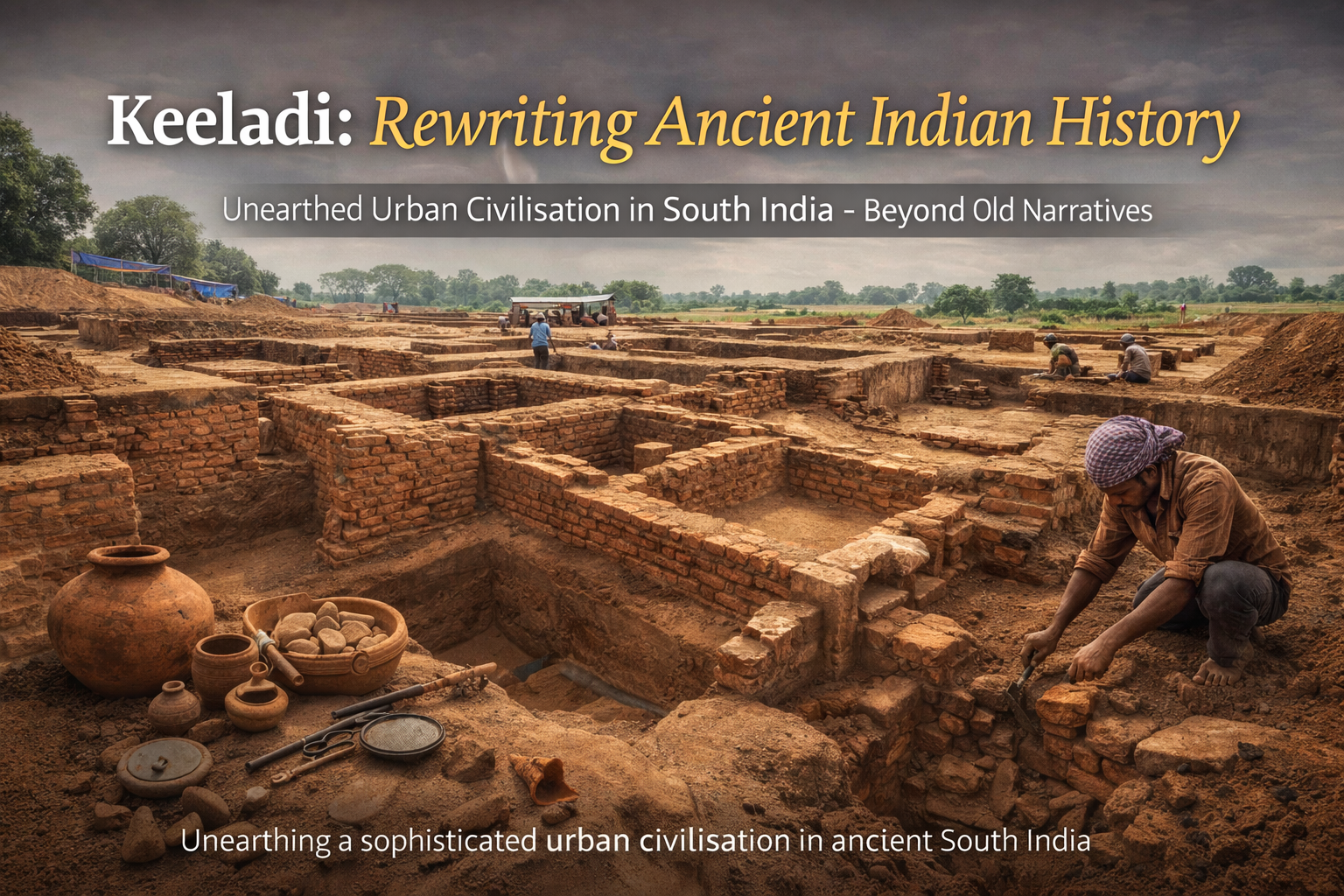
Revisiting Technological Lineage: How Keeladi Rewrites South India’s Development Story
For decades, the prevailing narrative in ancient Indian technological history often positioned the northern plains as the primary engine of innovation, with the southern peninsula frequently characterized as a recipient or passive inheritor of established methodologies. However, recent archaeological evidence, particularly from the extensive excavations at Keeladi, presents a compelling counter-narrative. For developers and those interested in the history of complex systems, this shift in understanding is crucial. It challenges us to move beyond simplified, unidirectional models of technological diffusion and instead consider parallel, indigenous development pathways. This archaeological revelation forces us to re-examine how early technological maturity manifested across the subcontinent, demanding a more nuanced view of ancient engineering and administrative capacity.
Deciphering Epigraphy: The Localized Development of Script and Communication
One of the most significant aspects of the Keeladi findings relates to the script recovered. The symbols found demonstrate a clear evolution that predates or runs concurrently with other established scripts, suggesting an indigenous trajectory for the development of written communication. From a systems perspective, the creation of a standardized, writable script represents a foundational technology. It is the necessary precursor for complex record-keeping, administrative automation, and the transmission of specialized knowledge across generations—the ancient equivalent of version control and standardized documentation.
When we analyze this script, we are looking at an early form of information technology. The challenge for ancient engineers and administrators was standardization and portability. If the script was developed locally, it implies a localized need for tracking trade metrics, agricultural yields, and perhaps even early forms of governance documentation. This suggests that the infrastructural requirements for complex society were met through internal innovation rather than simply adopting external schemas. For modern developers, this mirrors the necessity of building bespoke tooling when off-the-shelf solutions do not meet unique domain requirements.
Material Science and Urban Infrastructure: Engineering Beyond Expectation
The urban planning and material science evident at Keeladi further underscore a high degree of independent technological sophistication. The construction techniques, water management systems, and the quality of craftsmanship in artifacts reveal an understanding of applied physics and material properties. Consider the ceramic industry. The uniformity and firing temperatures achieved imply precise control over thermal dynamics—a fundamental aspect of process engineering.
In contemporary development, we constantly strive for efficiency and robustness in our deployed systems. Similarly, ancient urban centers required robust, fault-tolerant infrastructure. The ability to source materials, manage supply chains for construction components, and implement drainage systems that function over centuries speaks to a highly sophisticated project management capability. This wasn’t rudimentary building; it was engineered infrastructure designed to support a high-density population and maintain long-term operational viability, challenging the notion that such engineering prowess only traveled southwards along established communication corridors.
Trade Networks and Economic Algorithms: Indigenous Complexity in Commerce
The presence of artifacts indicating extensive trade, coupled with localized coinage or weights and measures, points toward the development of sophisticated economic algorithms. Trade, at its core, is a distributed ledger system. Managing exchanges across distances requires agreed-upon standards for valuation, measurement accuracy, and dispute resolution.
If Keeladi was successfully engaging in long-distance trade, the technological backbone supporting this was likely homegrown. Developing a reliable system for quantifying value and ensuring fair exchange requires abstract mathematical thinking and administrative discipline. This level of economic coordination suggests that the cognitive tools necessary for advanced societal organization—the ‘software’ of governance and commerce—were already matured within the region, rather than being imported wholesale. It signifies an independent optimization path for managing resource allocation within a growing ecosystem.
The Developer’s Perspective: Embracing Localized Innovation
The Keeladi findings offer a powerful metaphor for modern software development. We are often encouraged to adopt the latest globally popular frameworks or established architectural patterns. While standardization has its merits, history shows that true leaps in technology often emerge from addressing specific, local constraints with novel solutions. The context of the ancient Tamil region—its geography, resources, and societal needs—drove its unique technological responses.
As developers, we must be vigilant against assuming that the most visible or loudest technological narratives represent the entirety of progress. Just as Keeladi proves that sophisticated engineering and communication systems developed autonomously in the south, contemporary teams should validate whether established “best practices” truly solve their unique architecture or domain problems, or if an indigenous, context-specific solution might yield superior performance and resilience. Rejecting the idea of passive reception encourages a proactive stance towards innovation, recognizing that complexity can arise organically wherever necessity demands it.
Key Takeaways
- Technological maturity, evidenced in script and engineering, developed in parallel across ancient India, not solely from a single northern source.
- Early material science and urban planning demonstrate independent optimization for resource management and robust infrastructure deployment.
- Complex trade necessitates localized development of economic “algorithms” for standardization and value exchange.
- Modern developers should apply the Keeladi lesson: local context often dictates the most effective, independently derived technological solutions.
- Historical narratives require continuous revision based on empirical evidence, mirroring the iterative nature of software development.