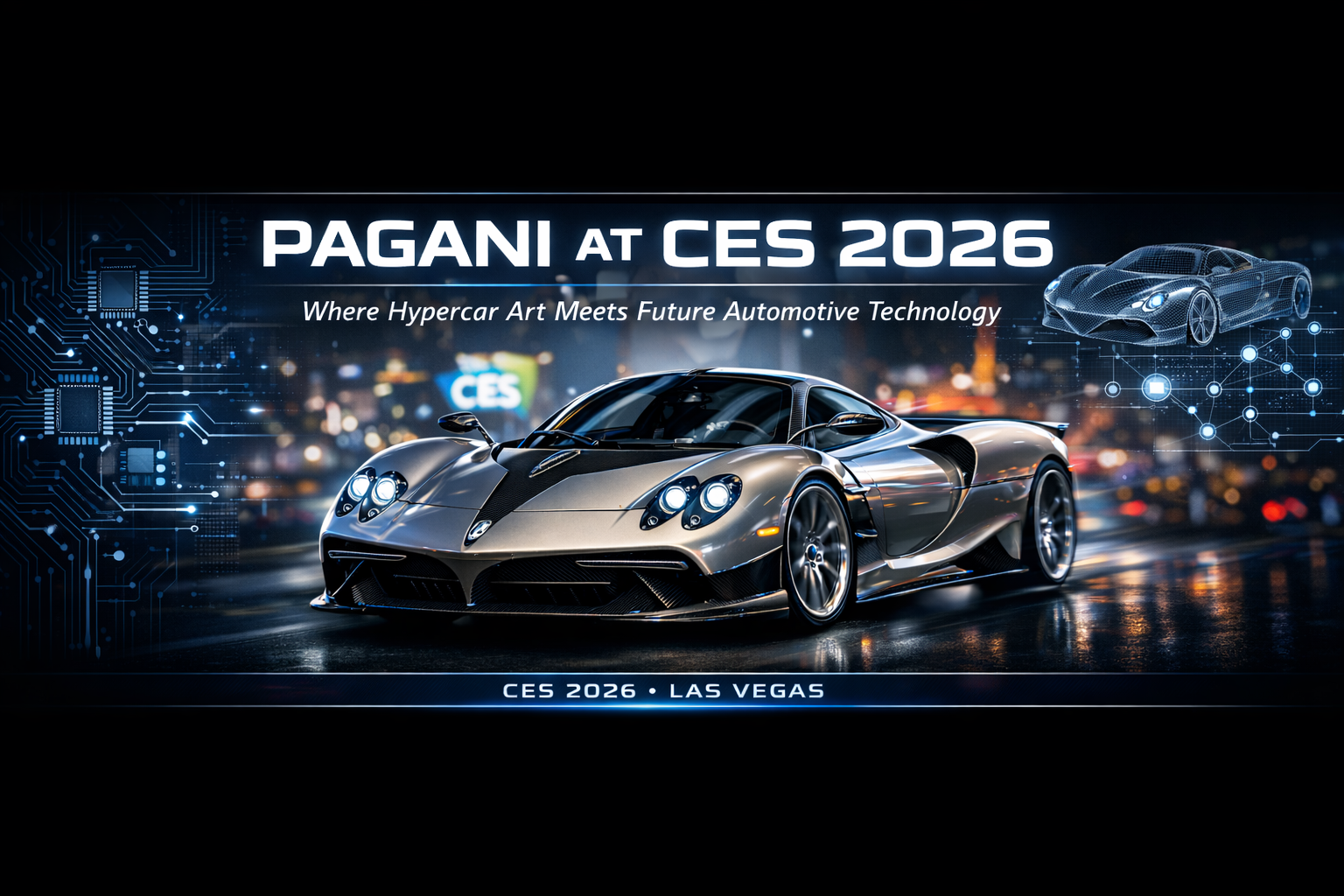
Pagani Showcases Technology & Hypercars At CES 2026 – duPont REGISTRY News
The recent Consumer Electronics Show in 2026 marked a significant pivot for the high-performance automotive sector. While traditionally known for consumer gadgets and software, CES has increasingly become a proving ground for automotive innovation, particularly where embedded systems and advanced materials intersect with extreme engineering. This year, the presence of ultra-luxury, low-volume manufacturers signaled a deeper integration of cutting-edge development practices into vehicles where performance demands are literally the highest on the road. For developers steeped in embedded systems, real-time operating systems (RTOS), and advanced sensor fusion, these showcases represent the bleeding edge of applied technology.
The Shift from Mechanical Purity to Software Dominance
For decades, automotive excellence in this segment was measured purely in mechanical terms: horsepower, downforce, and material rigidity. However, the narrative at CES 2026 clearly indicated a fundamental shift. The next generation of hypercars relies as heavily on firmware integrity as it does on carbon-fiber layup schedules. We saw demonstrations focused less on top speed figures and more on the efficiency and reliability of the vehicle’s digital backbone. This means complex, distributed computing architectures running on safety-critical processors are becoming standard. Developers are now tasked not just with performance optimization, but with ensuring ultra-low latency communication across the vehicle’s domain controllers, a problem set familiar to those working in high-frequency trading or aerospace systems.
Advanced Haptic Feedback and User Interface Engineering
One of the most compelling demonstrations involved next-generation driver interfaces. Moving beyond traditional touchscreens, the showcased systems integrated highly nuanced haptic feedback directly into physical controls. This isn’t simple vibration; it involves fine-grained motor control within switches and dials that communicate tire slip, brake pressure limits, or impending aerodynamic instability directly to the driver’s fingertips. From a developer standpoint, this requires sophisticated algorithmic modeling of physical phenomena and translating those models into actionable, tactile outputs via actuators. The control loops involved are demanding, requiring extremely deterministic behavior within the vehicle’s central infotainment or telemetry unit, often utilizing specialized microcontrollers optimized for precise PWM generation and feedback synchronization.
Real-Time Diagnostics and Predictive Maintenance Architectures
Another area receiving significant focus was the vehicle’s ability to self-diagnose and communicate its operational limits in real-time. In hypercars where component stress levels far exceed those of mass-market vehicles, predictive maintenance is not a convenience—it’s a necessity for operational safety. We observed demonstrations of embedded telemetry units utilizing machine learning models running locally (edge computing) to analyze sensor data streams, such as thermal profiles of specialized braking systems or stress fractures within structural composites. The architecture presented involved secure, authenticated data pipelines communicating health status back to remote engineering centers. For developers, this implies proficiency in developing constrained machine learning inference engines suitable for automotive-grade hardware, ensuring energy efficiency while maintaining high throughput on noisy sensor data.
Component Selection and Reliability in Extreme Environments
The technological showcase also highlighted the rigorous demands placed on component selection. When pushing boundary conditions—temperatures exceeding 100 degrees Celsius in the engine bay or cryogenic cooling systems for battery packs—standard commercial off-the-shelf components simply won’t suffice. The engineering discussions centered on sourcing and validating high-reliability silicon that can maintain timing margins and signal integrity under extreme vibration and thermal cycling. This drives developers to deeply understand hardware qualification processes, often involving custom firmware tailored to compensate for the non-linear behaviors of these specialized components. The robustness of the boot sequence and failover mechanisms for critical functions like powertrain management were heavily scrutinized, reflecting an industry-wide maturation regarding software accountability.
Key Takeaways
- The focus has shifted from raw mechanical specifications to the robustness and latency of the vehicle’s embedded software architecture.
- Next-generation HMI relies on complex, physics-based haptic feedback loops requiring deterministic control systems.
- Edge AI deployment is crucial for real-time, on-board predictive maintenance of high-stress components.
- Component selection and firmware specialization are necessary to ensure software reliability under extreme automotive operating conditions.