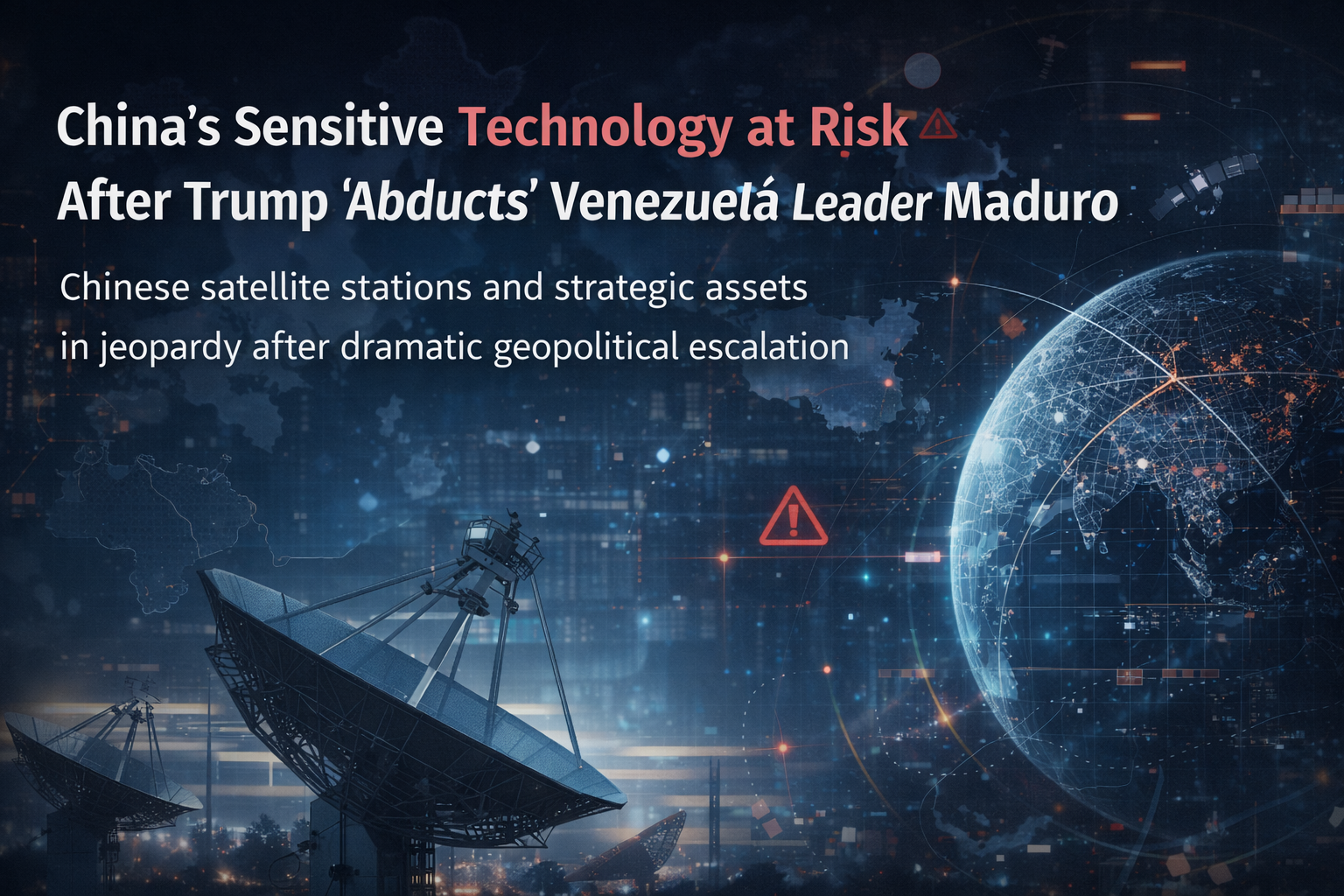
Geopolitical Shocks and Their Ripple Effects on Sensitive Technology Development
The intersection of international politics and cutting-edge technology has never been more fraught with tension. Recent high-stakes geopolitical maneuvers, such as those referenced in international reporting concerning the apprehension of a national leader in South America by a powerful external actor, serve as stark reminders that the digital and physical realms are deeply intertwined. For developers, engineers, and technology leaders focused on sensitive or strategically important projects—whether in AI, advanced manufacturing, or quantum computing—these political tremors necessitate a critical re-evaluation of supply chain security, data sovereignty, and operational risk management. This article examines the potential downstream impacts of such volatile international incidents on the ecosystem of sensitive technology.
Supply Chain Vulnerability in Geopolitical Flashpoints
When major world powers engage in maneuvers that escalate international friction, the immediate casualty is often the stability of complex, globalized technology supply chains. Developers building mission-critical systems rely on components, software libraries, and fabrication processes sourced from dozens of countries. A sudden political realignment or the imposition of new trade restrictions can instantaneously sever access to vital inputs. Consider the semiconductor pipeline: a highly complex chain where specialization exists across multiple continents. If political actors weaponize access to key lithography tools, specialized gases, or advanced chip designs, projects dependent on next-generation processors can face immediate and prolonged stagnation. Developers must move beyond just vetting their immediate suppliers; the focus must now extend to understanding the geopolitical risk profile of tier-two and tier-three providers, especially those operating near perceived conflict zones or under the sphere of influence of potentially aggressive regimes.
Data Sovereignty and Cloud Infrastructure Hardening
Sensitive technology development inherently involves handling data that requires the highest levels of protection, often mandated by national security or proprietary business interests. Geopolitical instability directly challenges the notion of stable cloud tenancy. If a government perceives another nation’s technological advancement as a direct threat, the legal frameworks governing data residency and access can shift overnight. Developers utilizing global cloud providers must anticipate scenarios where their access keys might be revoked, their data repositories frozen, or their connection pathways intentionally degraded due to regulatory capture or unilateral executive actions. This demands a shift toward highly decentralized, sovereignty-aware architectures. Solutions involving edge computing, encrypted distributed ledgers, and mandatory on-premise or sovereign-region failover capabilities are no longer niche requirements; they are foundational necessities for any project touching sensitive intellectual property.
The Impact on Open Source Collaboration and Trust Models
Much of modern software development, even in highly secure environments, rests upon a foundation of shared open-source components. Geopolitical stress tests the implicit trust model that underpins global collaboration. When diplomatic relations sour, the potential for state-sponsored actors to introduce subtle, difficult-to-detect vulnerabilities into widely used libraries increases significantly. Developers working on core infrastructure components must adopt extreme vigilance in their dependency scanning and code review processes. Furthermore, geopolitical tensions can lead to the fragmentation of developer communities themselves. Tools, forums, and collaborative platforms might become unreliable or politically biased, forcing engineering teams to wall off their environments, which inevitably slows down innovation through reduced cross-pollination of ideas and expertise.
Mitigating Risk: A Developer’s Checklist in an Unstable World
For technology teams navigating this landscape, adaptation is key. Risk management must be embedded into the entire Software Development Life Cycle (SDLC), not bolted on as a final compliance step. Practical steps involve rigorous scenario planning that assumes adversarial action from both foreign states and domestic regulatory bodies reacting to international events. Investing in domestic or allied-nation-sourced hardware alternatives, even at a short-term performance or cost penalty, builds resilience. Furthermore, engineers should prioritize building systems with “decoupling” capabilities—the ability to quickly swap out core dependencies (e.g., cryptographic libraries, communication protocols, or specific hardware accelerators) without requiring a complete system overhaul when a source becomes politically tainted.
Key Takeaways
- Geopolitical events create immediate, tangible risks to technology supply chains, demanding auditing beyond tier-one suppliers.
- Data sovereignty compliance now requires architectural decentralization and robust, verifiable cross-region failover strategies for critical workloads.
- The implicit trust underpinning open-source collaboration is eroding, necessitating heightened scrutiny of dependencies for intentional or unintentional vulnerabilities.
- Developers must prioritize building resilience through modular, rapidly swappable system components to mitigate dependence on politically sensitive technologies or sources.
- Scenario planning for forced disengagement from specific tools or geopolitical zones must become standard operating procedure for sensitive technology projects.