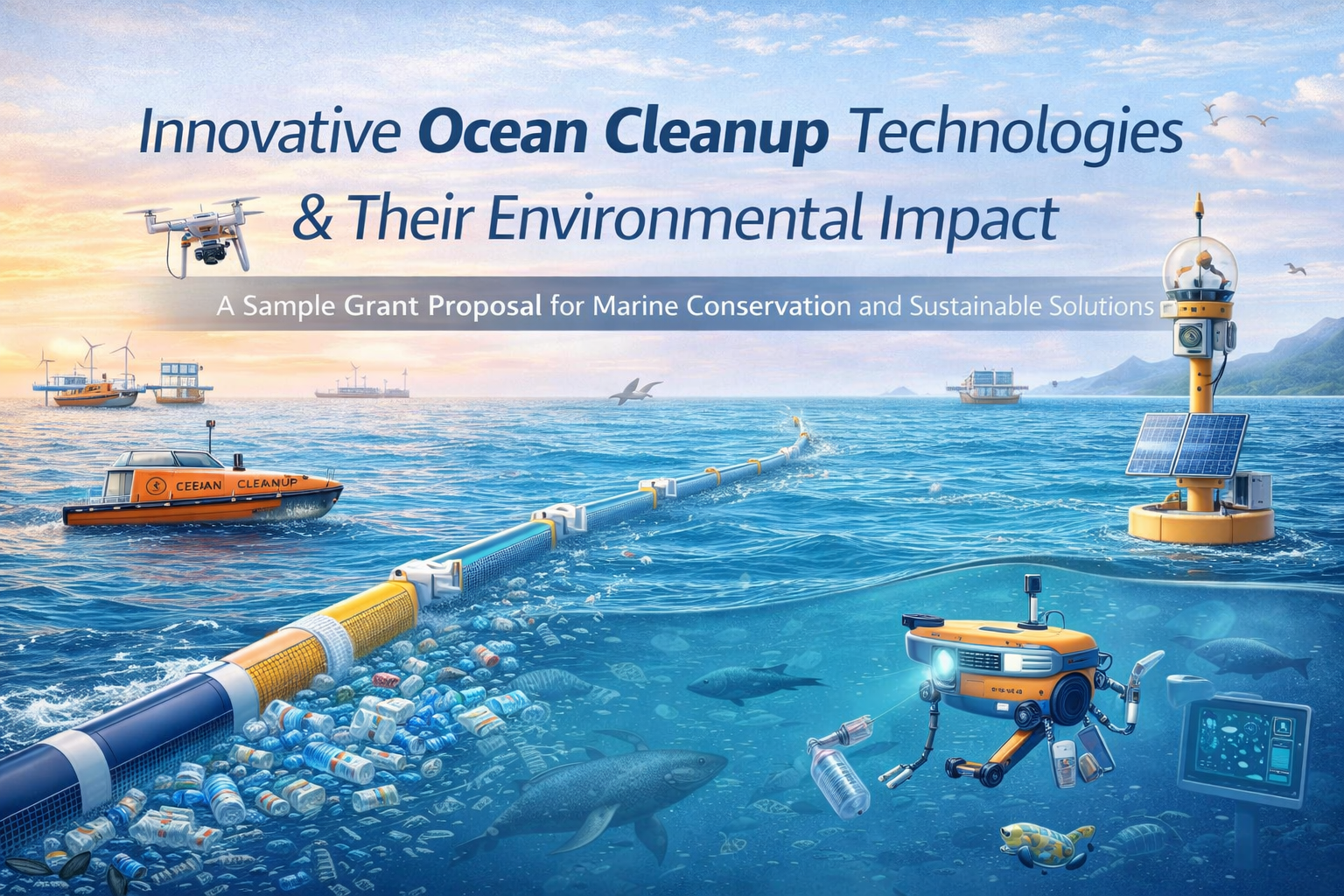
A Developer’s Guide to Structuring an Innovative Ocean Cleanup Technology Grant Proposal
Securing funding for groundbreaking environmental projects often hinges on the quality of the grant proposal. For developers and engineers focused on innovative ocean cleanup technologies, the proposal is more than just a formality; it’s a technical specification, a feasibility study, and a roadmap all rolled into one persuasive document. This guide breaks down the essential components of a successful grant application, focusing on what technical reviewers look for when assessing novel environmental solutions.
Understanding the Funder’s Perspective: Beyond the Hype
Funders, particularly those focused on R&D and environmental impact, are looking for verifiable technical merit, scalability, and a clear return on investment—even if that return is measured in ecological improvement rather than profit. A common pitfall for technical teams is overemphasizing the novelty of the algorithm or hardware without clearly articulating the problem it solves and how it measures success. You must bridge the gap between complex engineering and actionable, measurable outcomes. Reviewers want to see that your proposed technology moves beyond proof-of-concept to a deployable, sustainable solution that addresses specific pollution vectors, such as microplastics, derelict fishing gear, or chemical runoff.
Section 1: The Problem Statement and Technical Justification
This section must be ruthlessly specific. Avoid vague statements about “saving the oceans.” Instead, define the target contamination source, its current concentration metrics, and the geographical scope. For a developer, this means integrating geospatial data analysis or sensor readings directly into the narrative. Justify why existing solutions fail. Do current filtration systems clog too easily? Are autonomous collection vehicles too energy-intensive? Your proposal should present preliminary data or simulation results proving the existing landscape is insufficient for the problem you are tackling.
The technical justification is where you introduce your innovation. Describe the core architecture. If your cleanup system involves AI for debris classification, detail the training data sets and the expected classification accuracy (precision and recall). If it’s a novel material science solution for passive collection, describe the thermodynamic properties or mechanical resilience under real-world oceanic stress conditions. Use clear, engineering-focused language, but define any specialized jargon for the interdisciplinary reviewers who might not be immersed in your exact sub-field.
Section 2: Methodology and Implementation Roadmap
This is the project plan—the blueprint for execution. A strong methodology section is inherently a Gantt chart translated into prose. Divide the project into clear, sequential phases. For instance:
- Phase 1: Simulation and Controlled Environment Testing (Focus on component reliability and core function validation).
- Phase 2: Small-Scale Prototype Deployment (Focus on energy efficiency and real-time data transmission protocols).
- Phase 3: Field Pilot and Impact Assessment (Focus on scalability and long-term maintenance requirements).
Crucially, specify the technology stack or hardware components you will use, and why they were chosen. If you are developing a low-power embedded system for remote sensing, detail the microcontroller selection and justify its trade-off between processing power and battery life. Address robustness; the ocean is a harsh testing ground. Detail how your system is designed to withstand biofouling, corrosive saltwater, and extreme weather events. Contingency planning is also vital—what happens if the primary collection mechanism experiences a predictable failure mode?
Section 3: Environmental Impact Metrics and Data Validation
This section separates aspirational concepts from fundable projects. How will you prove your technology works? Define quantifiable metrics of success tied directly to the initial problem statement. If the goal is plastic removal, the metric is mass or count of debris removed per operational hour, normalized against energy expenditure. If the goal is chemical neutralization, the metric is the measurable reduction in contaminant concentration within a defined zone, verified by independent analytical testing.
Data handling and validation are critical for developer-led proposals. Outline your data pipeline: how data is collected (sensor calibration and sampling rate), stored (cloud or edge processing), and analyzed. Transparency here builds trust. If you use machine learning, clearly state the validation dataset used to confirm the solution’s efficacy outside the training environment. Reviewers need confidence that the environmental benefit claimed is reproducible and not just an artifact of optimistic lab results.
Section 4: Scalability, Sustainability, and Budget Justification
Grant funding is often seed money. Reviewers need assurance that the project won’t simply vanish upon grant completion. Address scalability: can your pilot solution be manufactured affordably at scale, or does it rely on rare, custom-machined components? Discuss maintenance lifecycles. For autonomous systems, what is the estimated Mean Time Between Failures (MTBF), and what does servicing look like geographically?
The budget should directly map back to the methodology. Every major line item—hardware procurement, specialized software licenses, personnel time (broken down by engineering discipline), and field deployment costs—must be clearly justified by the tasks outlined in Section 2. Avoid large, amorphous budget categories. For instance, instead of budgeting $50,000 for “Prototypes,” detail $15,000 for sensor arrays, $20,000 for custom chassis fabrication, and $15,000 for integration labor.
Key Takeaways
- Anchor technical innovation in measurable environmental outcomes, avoiding vague claims.
- Structure the methodology as a phase-gated engineering project with clear deliverables for each stage.
- Provide specific details on data validation protocols, ensuring transparency in performance metrics.
- Justify all budget items directly against the proposed work plan and demonstrate a path toward long-term operational sustainability.